Praem minista Carlot Salwai i kivim toktok blong hem afta long kot case blong Saturday 25th May 2024.
Long kot kes ia we krup blong vot no oli putum akensem kavman, PM Salwai i talem se hemi welkam disisen blong krup no blong putum kes blong referandom ia long kot.
“Mi kamaot long media nomo blong talem se kot hemi sakemaot kes ia”
Wajem video blong save moa infomesen.
The Official Results
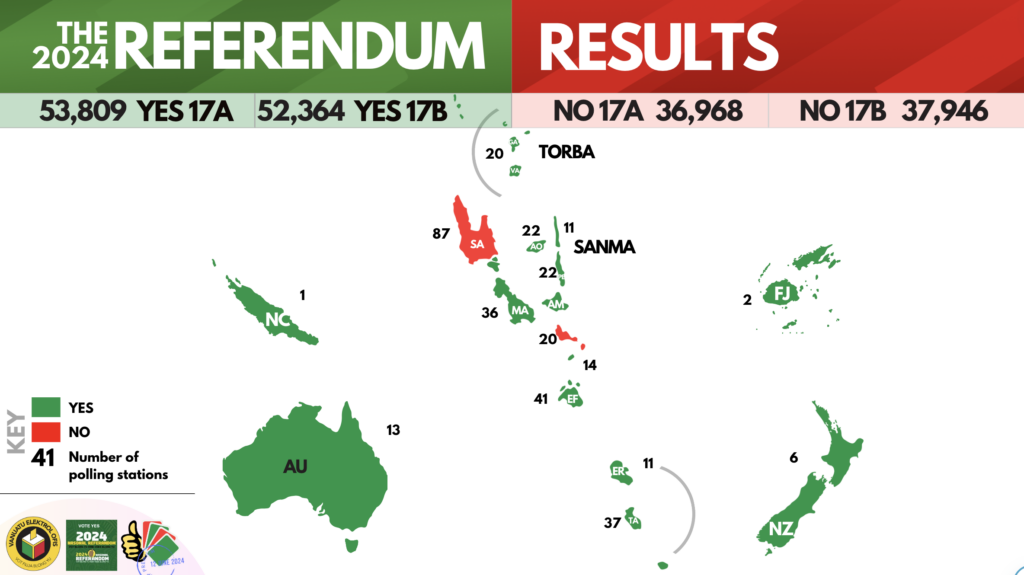
The map uses green and red shading to represent the outcomes of the 2024 National Referendum in Vanuatu, with each color corresponding to the majority vote in each area:
Green Shaded Areas: These regions have a majority of Yes votes for the referendum questions. The green areas highlight where the population predominantly supported the referendums.
Red Shaded Areas: These regions have a majority of No votes for the referendum questions. The red areas indicate where the population predominantly opposed the referendums.
Numbers on the Map: The numbers within each shaded area represent the number of polling stations in that specific region. This provides additional context to the vote distribution, indicating how many polling stations contributed to the result in each area.
We can also visualize the areas of attention in the 2024 National Referendum results, highlighted by the distribution of green and red shading can be understood as follows:
Regions with High Support (Green Areas)
Efate and Port Vila (Shefa Province): These areas show strong support for the referendum questions, indicated by the large number of green-shaded polling stations. Given their high population density and number of polling stations, these regions significantly influence the overall referendum outcome.
Tanna (Tafea Province): This area also shows considerable support for the referendum questions, which is critical as it reflects the political leanings of one of Vanuatu’s more populous islands.
Regions with High Opposition (Red Areas)
Santo (Sanma Province): This area is predominantly shaded in red, indicating a strong opposition to the referendum questions. Santo’s opposition is crucial due to its significant population and number of polling stations, which can substantially impact the overall results.
Epi (Shefa Province): Epi also shows strong opposition, which is notable given its smaller size but clear stance against the referendum questions.
Balanced or Mixed Regions
Pentecost (Penama Province) and Malekula (Malampa Province): These areas might have mixed or lighter shades, reflecting a more balanced outcome between Yes and No votes. The close results in these areas highlight regions with divided opinions, which can be critical in understanding the nuanced public sentiment and potential areas for further political engagement or clarification.
Overseas Votes:
Australia, New Zealand, Fiji, and New Caledonia: These areas show the voting patterns of Vanuatu citizens living abroad. While their numbers might be smaller, their voting trends (as indicated by the shading) provide insight into the diaspora’s perspective on national issues, which is vital for a comprehensive understanding of the overall voter sentiment.
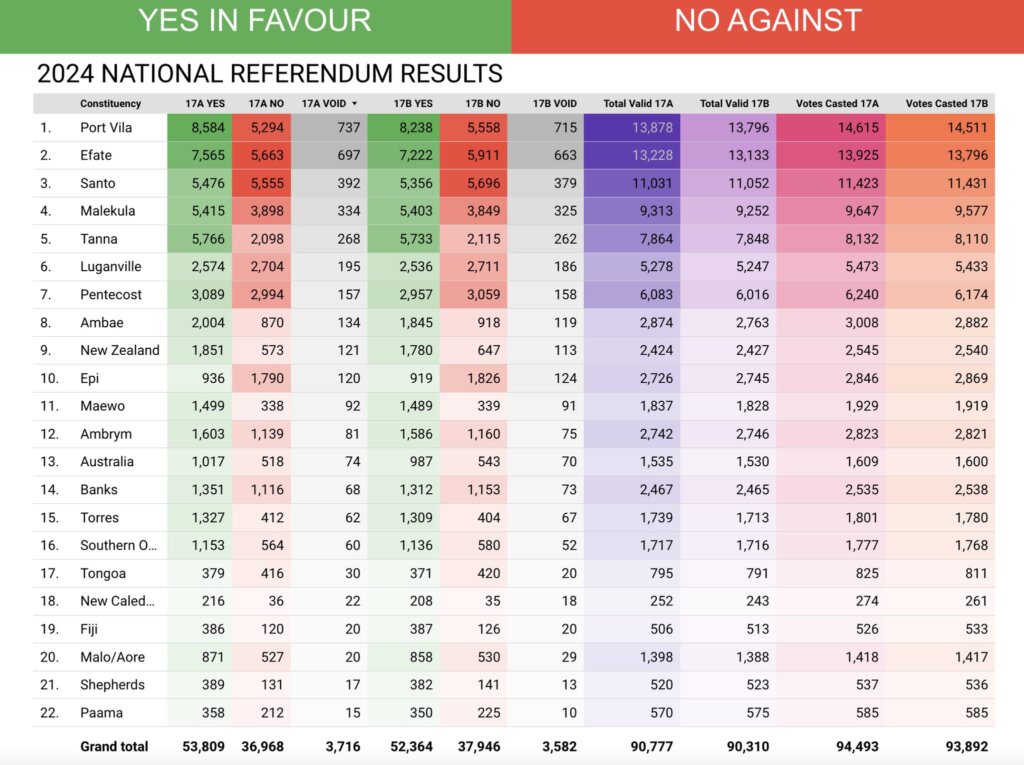
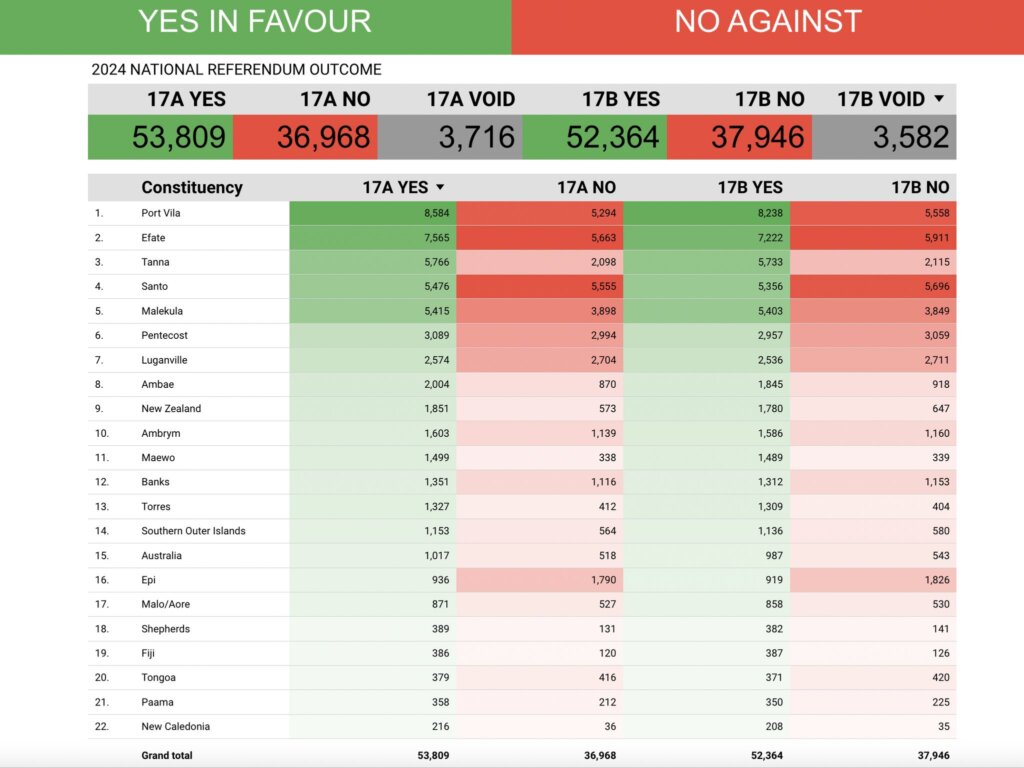
The information here presents the results of the 2024 National Referendum in Vanuatu, detailing the votes for two referendum questions (17A and 17B) across various constituencies and provinces. Each row includes the number of Yes, No, and void votes for both 17A and 17B, along with the total valid votes and the total votes casted for each question. The results are broken down by constituency within each province, as well as for overseas voters in Australia, New Zealand, Fiji, and New Caledonia.
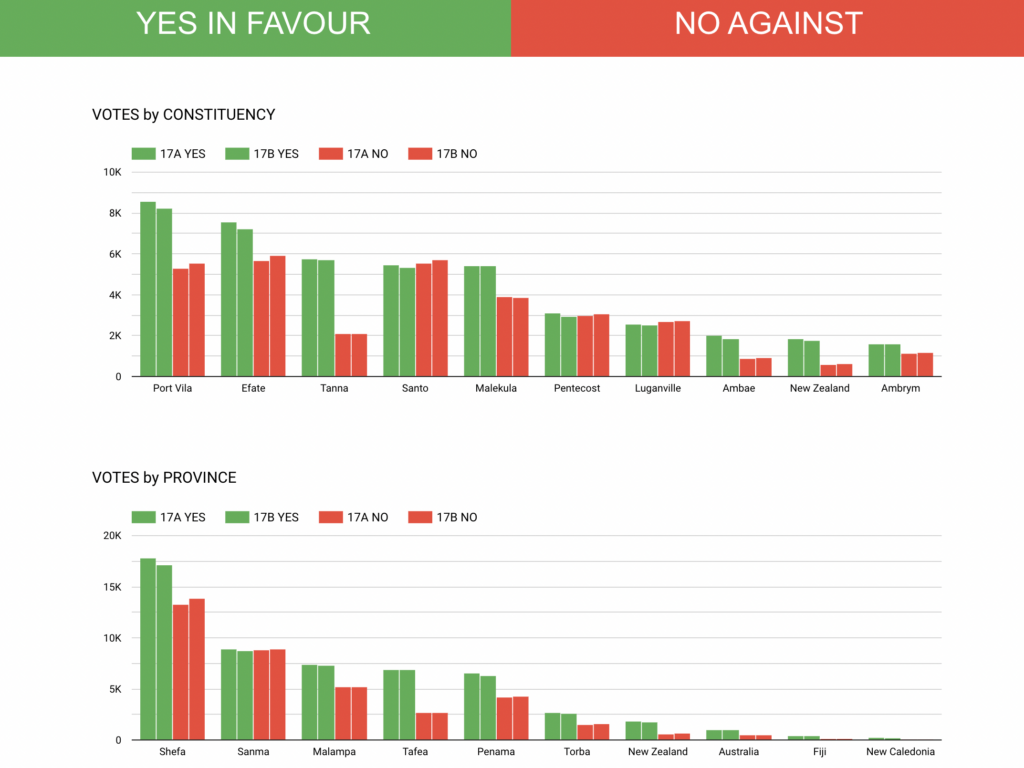
The 2024 National Referendum in Vanuatu showed diverse regional voting patterns. Key areas of strong support included Efate and Port Vila in Shefa Province, as well as Tanna in Tafea Province, with significant Yes votes. Conversely, regions such as Santo in Sanma Province and Epi in Shefa Province demonstrated notable opposition with majority No votes. Mixed results were observed in places like Pentecost and Malekula. Overseas votes from Australia, New Zealand, Fiji, and New Caledonia also contributed, generally leaning towards support for the referendum questions.
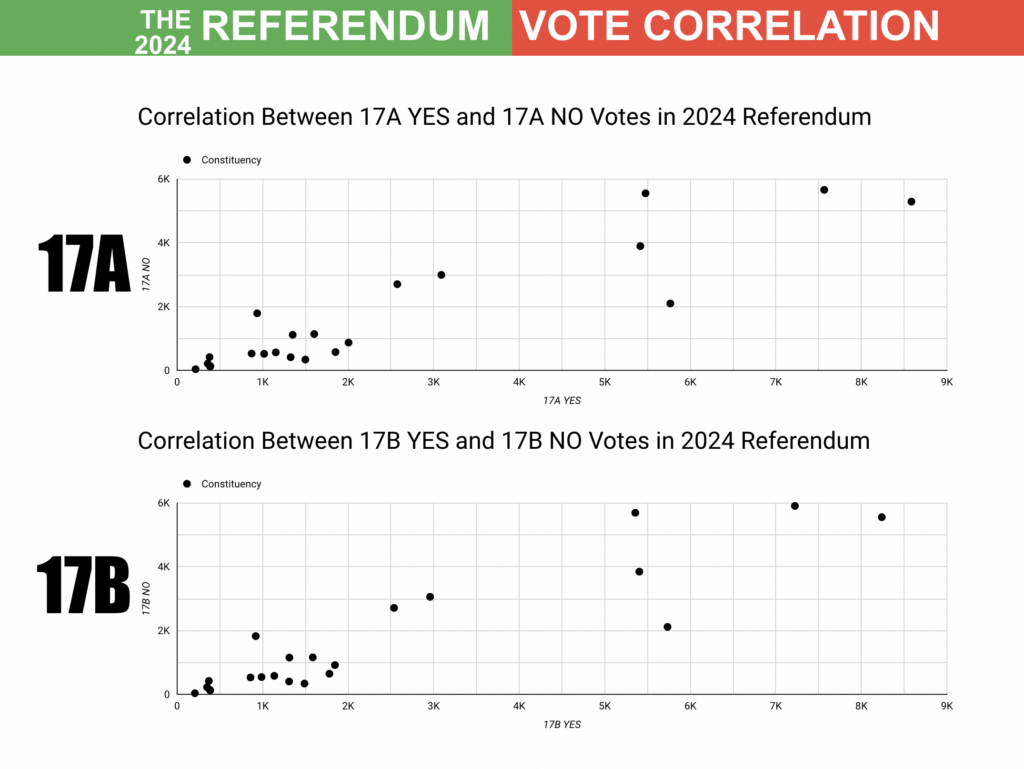
The scatter plot visualizes the relationship between YES and NO votes for each constituency. Each data point represents a constituency, positioned based on its YES votes (X-axis) and NO votes (Y-axis). This graph helps identify patterns, such as whether constituencies with high YES votes also have high NO votes, or if there is significant variability, and it aids in understanding overall voting trends and regional differences in the referendum results.
Vanuatu Vote Counting Nears Completion with 94% of Polling Stations Tallied
The counting teams are gearing up to tackle the overseas votes, which will complete the final 6% of the tallying process. This last leg of counting is crucial as it will provide the comprehensive results needed for the official declaration of the election outcome.
As of today, the process reflects a remarkable 94% completion rate, showcasing the dedication and efficiency of the counting teams. The final results from Fiji and New Caledonia are eagerly anticipated, as they will contribute to the overall electoral landscape of Vanuatu.
Stay tuned for further updates as Vanuatu moves closer to finalizing its vote counting process, ensuring every vote is counted and every voice is heard.
Dashboard
Counting estap Kohed, Ol yellow emi ol polling station we oli countem finis. Pink oli stap count naoia. White not oli no countem yet.
Commission chair eyes announcing results on June 10
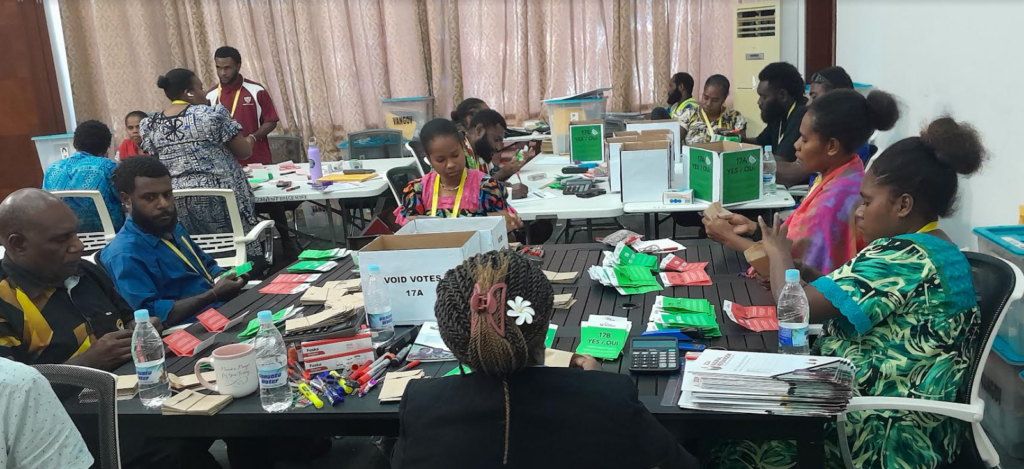
Dedicated young officers counting votes while Chairman Kaltamat is seen helping at left.
Judging from the current speed of counting, the Chairman of the Electoral Commission is confident all 379 ballot boxes including those from overseas, will be completed in less than two weeks.
“Thank you young team for speedy counting,” Chairman of the Electoral Commission, Mr. Edward Kaltamat said.
“If we can announce the result by June 10 then we may not need a further four or five days but, most likely one day extra, if we can complete SANMA tonight (05.06.24). Then we move on to count PENAMA and TORBA ballot boxes. We will, then, be able to complete all 21 overseas polling stations over the weekend.
“Once we produce the results, if we find one or two ballot boxes do not reconcile with the numbers as recorded in the box then we must recount the votes from the ballot box until we are satisfied.
“Even all the envelopes are kept to ensure that the number of votes counted is equal to the number of envelopes used.”
All votes cast are stapled together in tens to make it easy to count again for verification.
“What this means is that after counting all the votes we will cross check the numbers electronically to ensure they agree,” he said.
Mr. Kaltamat said verification could take two days before the results are announced to the nation. He praised his young officers who he said, have been with them for the last six months and are the contributants to the speedy progress in the completion of the first referendum vote counting in TAFEA, SHEFA and MALAMPA Provinces.
“Now we are on to the biggest constituency in the country which is SANMA Province which has over 90 polling stations. We hope to complete counting the votes tonight,” he said.
Observing a sense of energetic spirit displayed by the young officers as they call out “Valid 17A” or “Void 17B” as they drop each vote in its right ballot box, Kaltamat said, “My message to the young officers is that they are fully dedicated and are committed to stand up late into the night and even until the early hours of the next day, and they still have the energy to carry out their duties until they complete counting their ballot boxes.
“Other people may look tired but, these young people are physically strong and are motivated to keep counting until they finish each of their ballot boxes.
“This is very encouraging for the Commission, to witness such dedication”.
When asked about the future of the smart young officers that count, he said the Commission also “grooms them” for future potential political careers as the political future of the country belongs to them.
He named at least two members of his staff who were nurtured by the Commission to develop into dedicated Provincial Officers.
Wanem i Hapen long Dei 1 blong ‘Vote Counting’?
Yestete dei 1 blong kaontem ol vot blong 2024 nasonal referandom, tim blong elektoral ofis i stat wok long 9 klok long moning mo oli finis kaontem ol vot long 11 klok long naet olsem, mo oli kaontem blong Port Vila konstituensi nomo from i kat wan bikfala namba blong ol vota.
Tim i stat long moning oli seraot ol pepa long ol envelop fastaem mo oli putum tufala kala tugeta afta oli jes kaontem namba blong ol krin pepa we blong 17A mo 17B mo ol red pepa blong 17A mo 17B wetem ol nogud vot o void votes.
Part 1
Part 2
Part 3
Long laef video tete i soem wan kompetetif namba long saed blong krin mo red pepa mo prinisipol elektoral ofisa i talemaot se hemi wan gudfala turnout long ol man we i vot long Port Vila nomo be VEO i no save givim ol namba yet.
Yumi stap ekspektem risal blong i kamaot long nekis wik nomo afta we elektoral komisin hemi apruvum evri samting.
Tete bae tim stat kaontem ol vot blong ol poling stesen long Efate konstituensi bakeken.
Summary of Day 2 Voter Counting
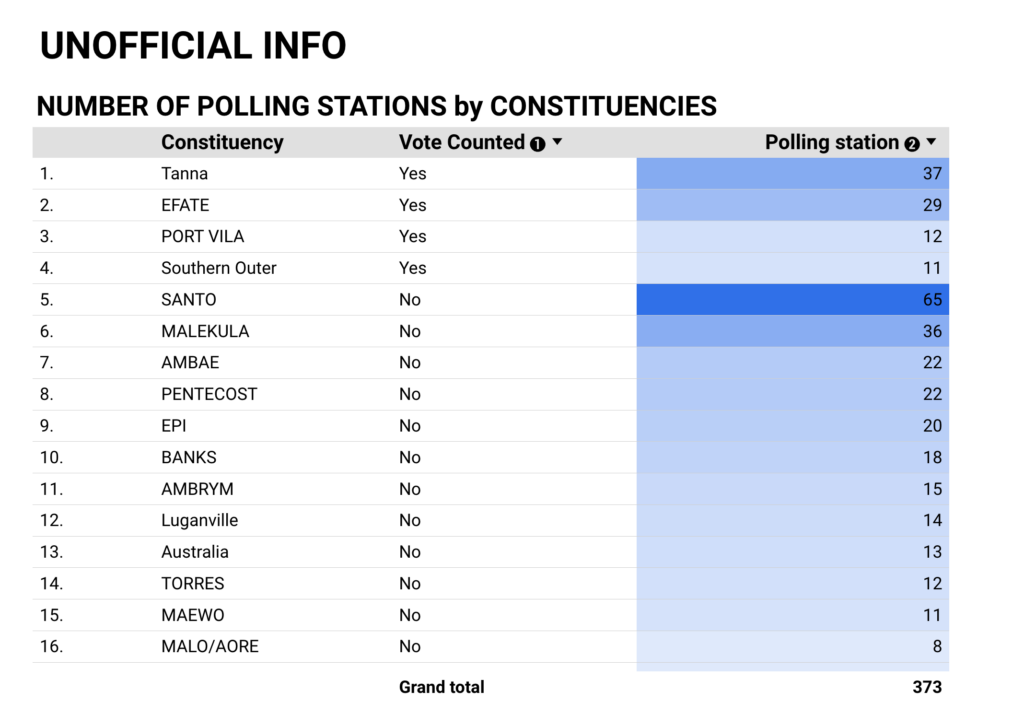
On Day 2, counting began at 9am, focusing on the 29 polling stations in Efate and its offshore islands. By noon, the counting team had completed Efate. They then moved to the South Outer constituency in Tafea Province, finishing the 11 polling stations there.
In the evening, counting continued for Tanna Island’s 37 polling stations, wrapping up at 3:30am. Tafea Province was fully counted by early morning.
On Day 3, the larger constituencies of Malekula (36 polling stations), Santo (65 polling stations), and Luganville (with high voter registration) will be tackled. Counting for Malekula will resume at 10am.
The counting is progressing steadily through the various provinces and islands, with the larger constituencies being saved for Day 3 due to their sizeable number of polling stations and registered voters.